
Used Books

The poet and critic Dana Gioia has produced a wonderful documentary about the life and mysterious death of the poet and artistic polymath Weldon Kees. It’s a curious subject … Kees is hardly remembered today, although well known in his time. You can watch it here … I highly recommend it. But this is not a review of the film, rather a reflection about books.
After watching the film, I decided to try to find a volume of Kees’ poetry. During his life he published several collections of poems, and his collected works were published after his death. Its notable that the collected edition was edited and introduced by Donald Justice, a poet of much greater renown, testament to the significance of the Kees work.
Copies at online booksellers were scarce, but given the prices, due to neglect rather than demand. There was a first edition rated fine, meaning it was exceptionally clean and in perfect shape, for $125. Further down the list was a later printing of the same edition, rated Good, which can mean anything, for $7.50. Sounds about right … I ordered it. The book arrived the day before a flight to Florida, so I stuffed in my bag to read on the plane.
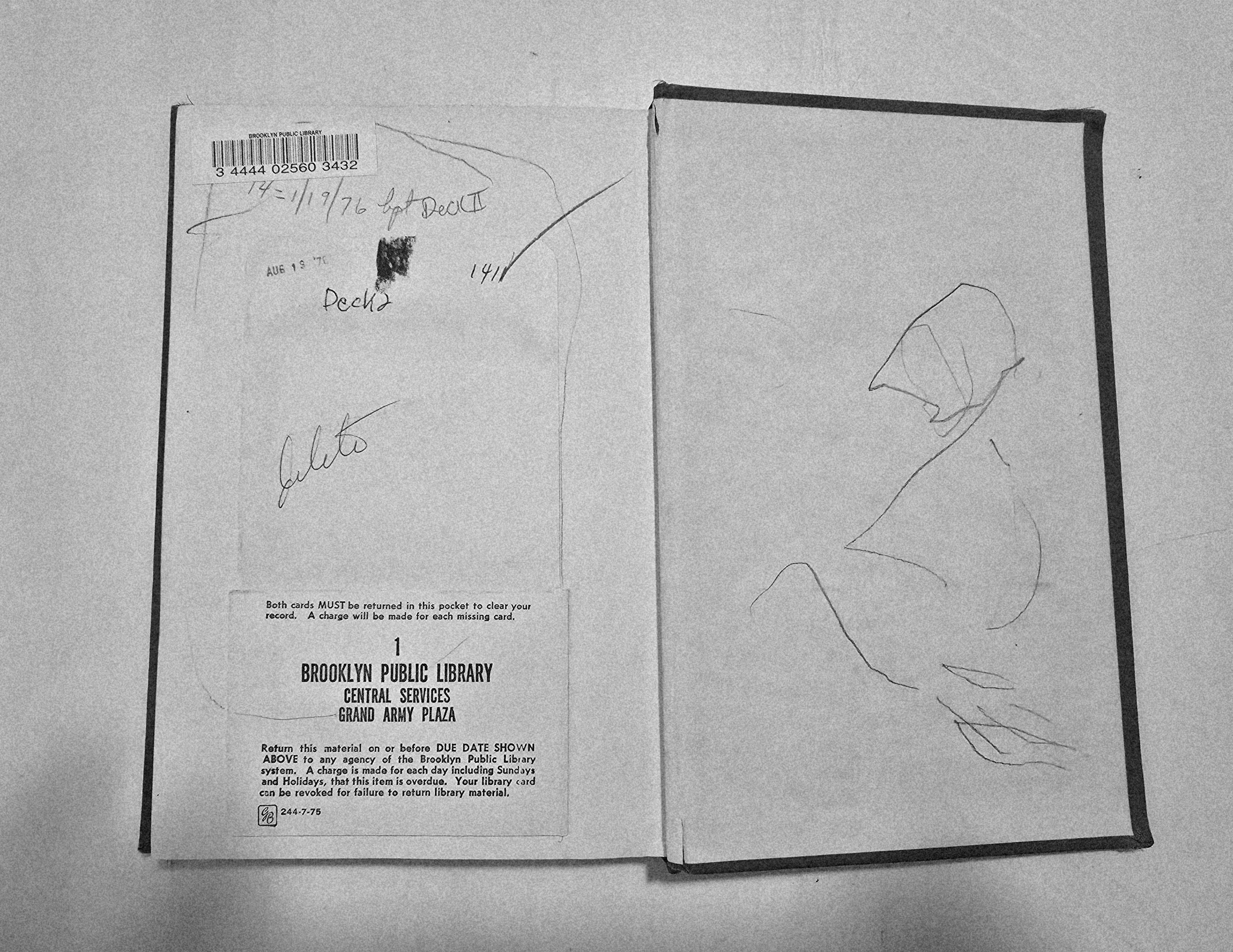
True to its rating, this is a rough ex-library book, likely culled from the stacks due to low demand. But the book had been read, sometime, a lot. The corners are worn, the pages are marked, the binding a bit loose. There are stickers indicating that it was once the property of the Brooklyn Public Library. The library card pouch is glued to the back page, alongside what looks to be a child’s pencil scribbling. A “Storage” sticker is pasted over the reference number on the binding, a badge of fate. The book came to the Booklyn Library sometime in the mid 70s, based on the stamps near the card pouch. The fine edition I passed up would have had no signs of the trail this book had traveled.
At 30,000 feet, I wondered to myself … who read this book before me? Seems unlikely to me that Kees would have part of a school assignment. Justice says in the preface that “Kees is one of the bitterest poets in history.” Quoting another, “Kees lived in a permanent and hopeless apocalypse,” yet coping with “the serenity of a saint.” Not the stuff of high school reports.
Who went over and over to these poems, and to this particular volume? A young poet looking for a voice in a desperate time? Perhaps someone in a small Brooklyn apartment, with children? Did she recommend it to others, repeated borrowings wearing out the edges of the book? Did they stuff it their bags like me? I don't know, of course.
Sometimes, if you are lucky, a used book, like this one, will come to you with some token of its legacy inside … markings, a note, a clipping, a grocery list. No more fine editions for me. The rougher the better, with all the richness of the trail. I think I will add my own mark to this one.
I think you found a copy of Kees’s poetry that recapitulates his literary afterlife. He had no institutional support in the classroom or library. If a library bought copies of his books, they soon discarded them. But there was always a small cult of readers. His books are expensive because there has always been a small but fanatical demand. The inexpensive ones are discards. Kees’s readers are, to use an image from Dostoevsky, underground men.
"Sometimes, if you are lucky, a used book, like this one, will come to you with some token of its legacy inside … markings, a note, a clipping, a grocery list. No more fine editions for me. The rougher the better, with all the richness of the trail. I think I will add my own mark to this one."
One of the great joys of a used and marked up book is how it leads to wonder: Who were these people? What did they do with the carrots and onions and chicken on their shopping list? I remember getting books from the library back in the day when they still used cards. I loved looking over the list of previous readers.